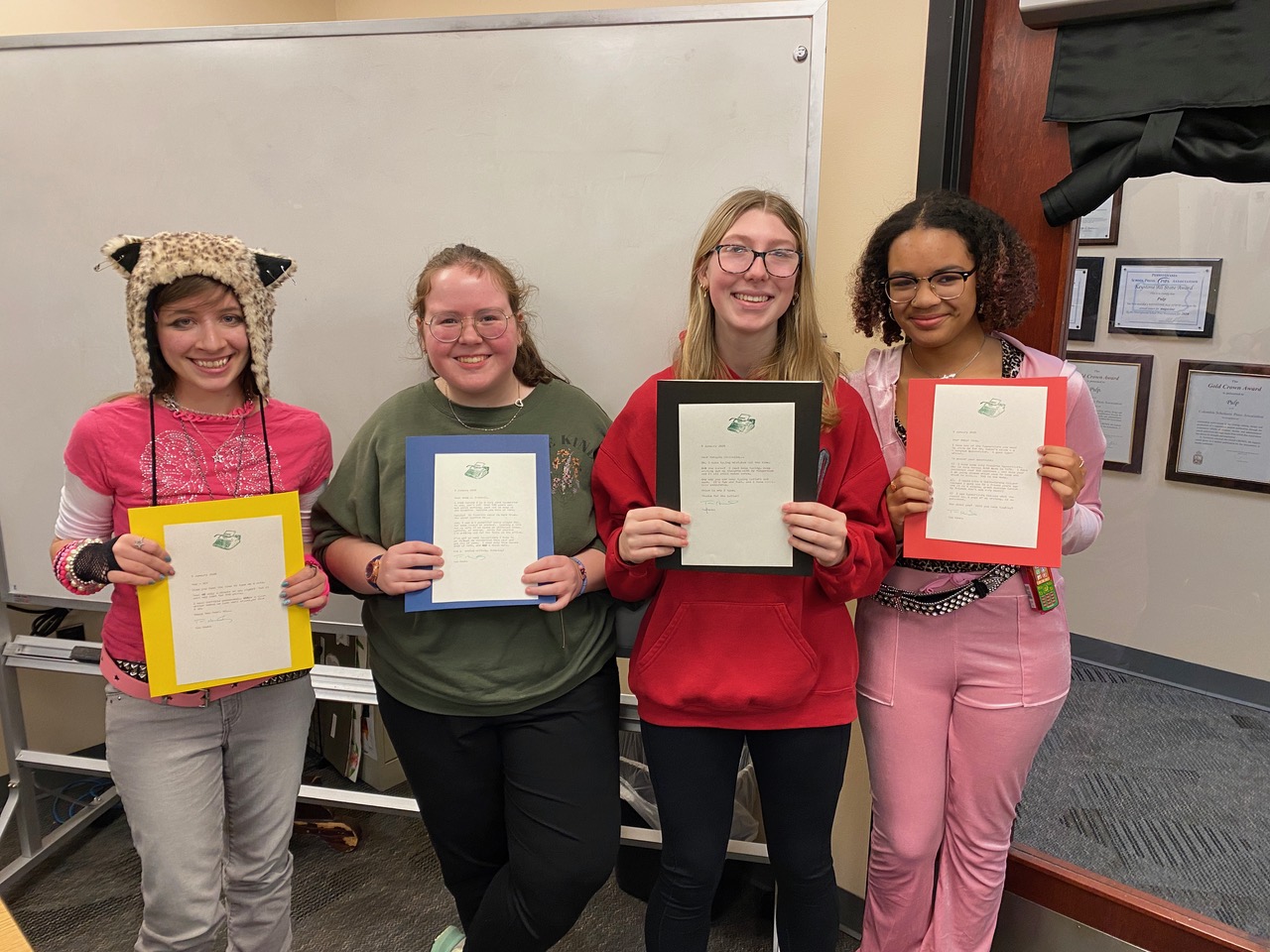
When students in Fred Durbin’s Analog Writing Class at Lincoln Park Performing Arts Charter School discovered that Tom Hanks was typewriter aficionado, they took to their manual vintage machines to connect with the actor.
The students mentioned what typewriter they were using to write the letter and asked him a variety of questions, including his favorite typewriters.
“This week, a package arrived from California. In it, we were delighted to find that Tom Hanks (type)wrote a personal response to each of the kids who wrote him a letter,” says Durbin.
Hanks responded to each individual student with answers to their specific questions and details on some of his favorite typewriters and why he liked that model. Among the responses he sent to sophomore Anna Shimeall from the North Hills was this: “And, I use a typewriter every single day, for some reason or another. Leaving a note for my wife if we leave at different times. Letters, of course. Notes for stories I’m writing and for the folks at the office.”
The students in Durbin’s Analog Writing Class use vintage typewriters from Durbin’s own collection of nearly 100 classic machines, learning not just how to operate typewriters (including the lost art of touch typing), but how to use them to create original work.
Durbin, a renowned writer of speculative fiction (A Green and Ancient Light, The Star Shard), has developed a class that’s as much philosophical as practical. Using professor Richard Polt’s The Typewriter Revolution–the “bible” for typewriter enthusiasts–as a textbook, Durbin and his 20 students are embarking on a quest that rewards hands-on creation.
“The typewriter keyboard is unforgiving,” says Durbin. “If you hit the wrong key at the wrong time, you have an error printed in crisp black and white on the page. You’re committed. There is no easy backspace and redo. You can correct the mistake using a Ko-Rec-Type strip, which we use in class, but it takes more deliberate work and slows you down. The typewriter teaches you to think more in your head, before you write, than with your fingers.”
Since Lincoln Park became a device-free school this semester, the course is perfectly timed, and no mere novelty. It’s teaching students the value of physical objects and skills, and offers a welcome alternative to today’s soulless, AI-dominated landscape.
“This course is designed to help students focus deeply on one thing at a time,” says Durbin, “to concentrate without distractions and to have meaningful interactions and conversations with others both in real time and in written conversations across time and space through the printed word. It also helps students be tactile, sensory beings in a physical world while also practicing the good, clear, meaningful art of written communication.”
While Durbin says it is too early to have any data in his class, he explains that there is a high school teacher, Ryan Adney, in Phoenix, who uses typewriters regularly in his English classes. He notes measurable improvement in spelling when students use typewriters. They can’t rely on spell-check, so they must look up words in dictionaries and have to pay attention to what words look like on the page. “I think that’s a major key to good writing – learning to see what’s on the page because what we see there is often different than what we think is there,” adds Durbin.
Left to right) Senior Sarah Cowan, New Castle, sophomore Anna Shimeall, North Hills (Pittsburgh), sophomore MaKayla Ciminella, Aliquippa and sophomore Ambyr Clay, Baden. All are Writing & Publishing majors at Lincoln Park.
Thank you,
Glenda, Charlie and David Cates
Let us know if you enjoyed this post!

Like

Love

Happy

Haha

Sad