
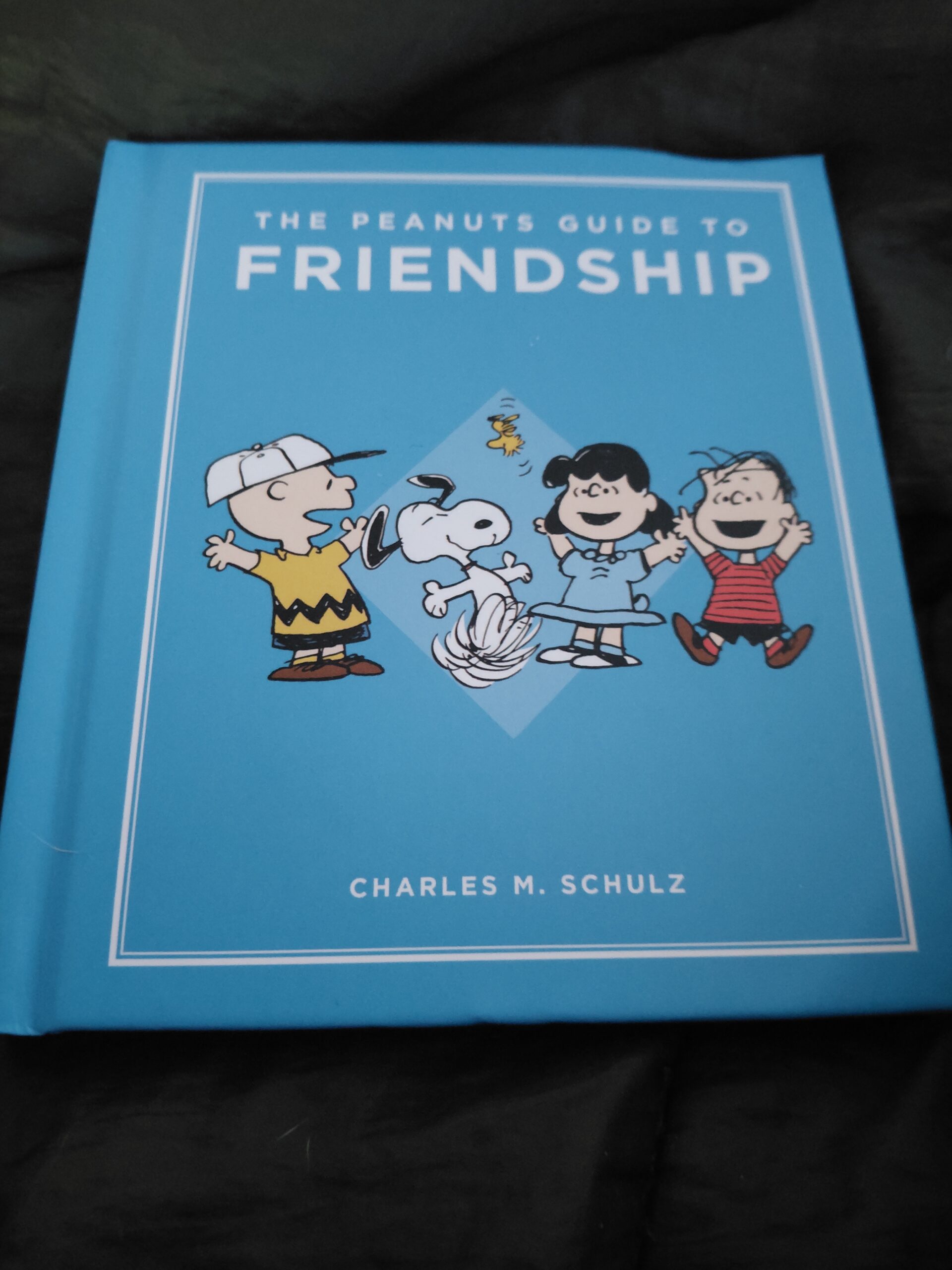
For my family there is books that feel like a quick read, and then there are books that feel like they settle in with you for a while, like they’ve quietly taken a seat on the couch beside you while life keeps moving around the house. I couldn’t wait to let you know The Peanuts Guide to Friendship (Peanuts Guide to Life) is very much the second kind.
This may be a small book but the collection, built around Charles M. Schulz’s beloved Peanuts characters, doesn’t try to reinvent anything or overcomplicate what friendship should look like. Instead, this book leans into what has always made Peanuts so enduring: honesty, simplicity, and those small, sometimes awkward, sometimes sweet moments that actually define how people connect.
As I went through the book, I kept thinking about how naturally it fits into a home like ours, where Peanuts has already been part of the background for years. I also like how reading the story reminded me of my childhood and reading the Sunday’s comics which was one of those series that quietly sticks.
Charlie Brown, Snoopy, Lucy, Linus, Woodstock—each one carrying a personality that somehow feels familiar even when you’re revisiting it after a long stretch. There’s something comforting about that. Everyone usually has their favorite character.
What stood out most in The Peanuts Guide to Friendship (Peanuts Guide to Life) is how it gathers those familiar comic moments and threads them together around friendship in all its forms. Not just the easy kind, but the complicated kind too. The unexpected bonds, like Peppermint Patty and Marcie, sit right alongside the steady, unshakable connection between Charlie Brown and Linus. Even Snoopy and Woodstock’s quiet companionship says a lot without needing to explain itself.
This litte book id the kind of book that doesn’t rush you. You can open it, read a page or two, set it down, and come back later without feeling like you’ve lost your place in anything important. That makes The Peanuts Guide to Friendship (Peanuts Guide to Life) especially fitting for younger readers or anyone who prefers something approachable. The book also feels like a natural bridge for kids who are just starting to read on their own, because the format doesn’t overwhelm them, but still gives them something meaningful to sit with.
There was one line that really stuck with me, the kind that makes you pause for a second longer than you expect. “Dogs accept people for what they are.” It’s simple, almost easy to overlook, but it carries that classic Peanuts kind of truth hidden in plain sight. Snoopy has always been more than just a comic dog, and that small reminder says a lot about loyalty, acceptance, and the kind of friendships that don’t demand perfection.
The Peanuts Guide to Friendship (Peanuts Guide to Life) also fits beautifully into the idea of our summer gift guide. It’s not loud or flashy, but it has that timeless quality that works for gifting across generations. My family loved how the story feels just as appropriate for a child flipping through pages on a quiet afternoon as it does for a parent sharing a few moments of nostalgia with them. There’s something about Peanuts that naturally pulls families into the same space, even if just for a little while.
And around Father’s Day, it really starts to make even more sense. The book has that quiet, shared-reading energy—something a dad and child can sit with together without needing anything extra. Just a book, a few familiar characters, and the kind of humor and warmth that doesn’t need explaining.
In our own home, Peanuts has never really been “just a book series.” It’s part of a longer thread that’s been there through childhood moments, decorations, little collections, and memories that build up without you always noticing they’re happening. The Peanuts Guide to Friendship (Peanuts Guide to Life) feels like it fits right into that same space, like it belongs on the same shelf where those familiar characters have always lived.
About the book: The Peanuts Guide to Friendship (Peanuts Guide to Life)
Celebrate the joys (and challenges) of friendship with Peanuts in this charming, beautifully packaged, officially licensed gift book for fans of Snoopy, Charlie Brown, Lucy, and the rest of Charles M. Schulz’s beloved characters.
There are many great examples of friendships, all special, among the Peanuts gang. There’s the unlikely closeness between Peppermint Patty and Marcie, the camaraderie of Snoopy and Woodstock, and the unwavering bond between Charlie Brown and Linus. Join Charlie Brown, Snoopy, Woodstock, and friends for reflections on these special relationships and how to care for them. Filled with delightful illustrations from the comics, this tender book is a perfect gift for friends who enrich our own day-to-day adventures.
Meet the Author Charles M. Schulz

Charles M. Schulz was born November 25, 1922, in Minneapolis. His destiny was foreshadowed when an uncle gave him, at the age of two days, the nickname Sparky (after the racehorse Spark Plug in the newspaper strip Barney Google).
In his senior year in high school, his mother noticed an ad in a local newspaper for a correspondence school, Federal Schools (later called Art Instruction Schools). Schulz passed the talent test, completed the course and began trying, unsuccessfully, to sell gag cartoons to magazines. (His first published drawing was of his dog, Spike, and appeared in a 1937 Ripley’s Believe It Or Not! installment.)
Between 1948 and 1950, he succeeded in selling 17 cartoons to the Saturday Evening Post—as well as, to the local St. Paul Pioneer Press, a weekly comic feature called Li’l Folks. It was run in the women’s section and paid $10 a week. After writing and drawing the feature for two years, Schulz asked for a better location in the paper or for daily exposure, as well as a raise. When he was turned down on all three counts, he quit.
He started submitting strips to the newspaper syndicates. In the spring of 1950, he received a letter from the United Feature Syndicate, announcing their interest in his submission, Li’l Folks. Schulz boarded a train in June for New York City; more interested in doing a strip than a panel, he also brought along the first installments of what would become Peanuts—and that was what sold. (The title, which Schulz loathed to his dying day, was imposed by the syndicate). The first Peanuts daily appeared October 2, 1950; the first Sunday, January 6, 1952.
Diagnosed with cancer, Schulz retired from Peanuts at the end of 1999. He died on February 13, 2000, the day before Valentine’s Day—and the day before his last strip was published—having completed 17,897 daily and Sunday strips, each and every one fully written, drawn, and lettered entirely by his own hand—an unmatched achievement in comics.
Affiliate Disclosure: This post may contain Amazon affiliate links. If you purchase through these links, I may earn a small commission at no extra cost to you.
Let us know if you enjoyed this post!

Like

Love

Happy

Haha

Sad