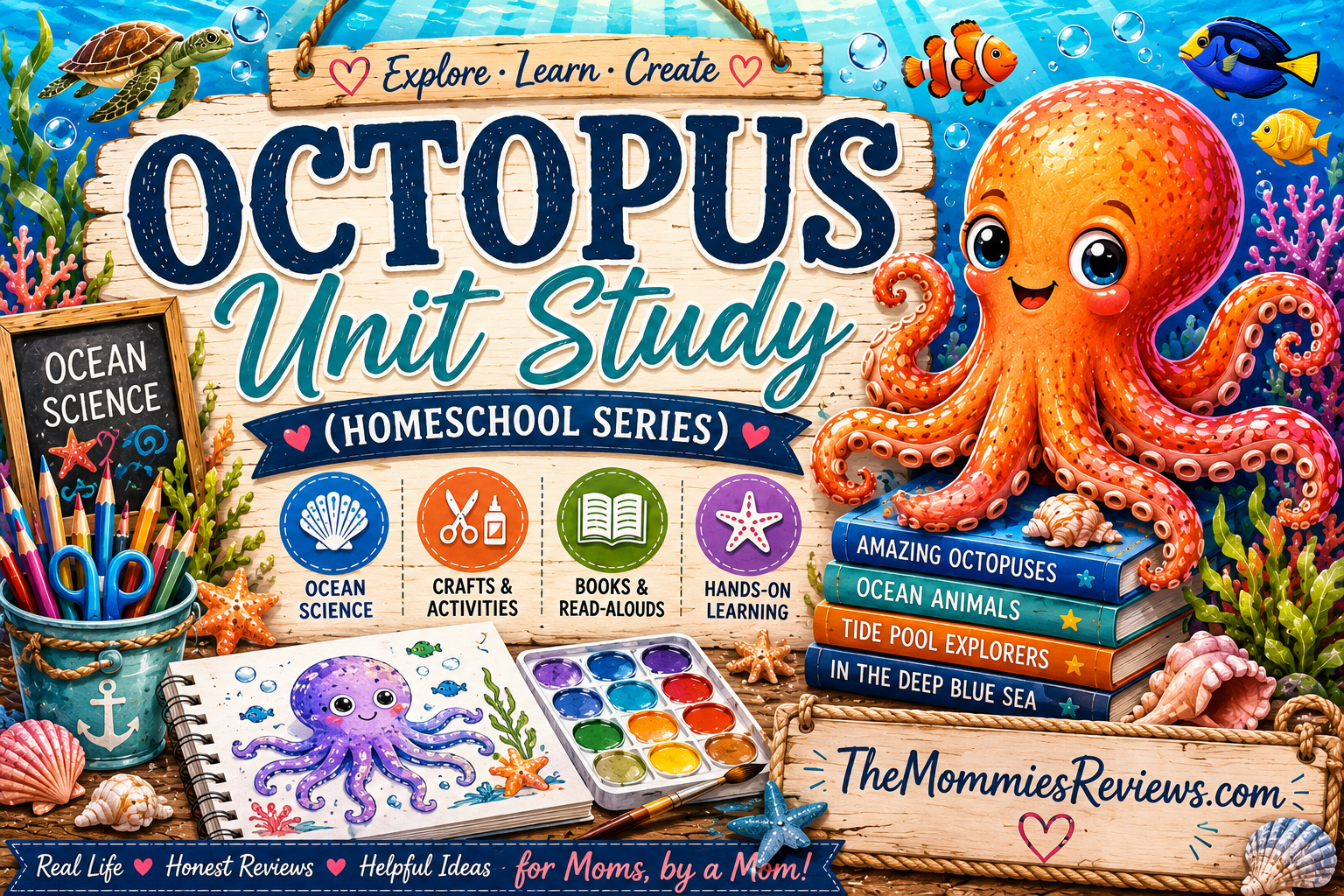
Charlie and I wanted to share another post in our Octopus Unit Study (Homeschool Series) — Day 2: Hands-On Learning Lesson with you. This lesson plan is good for younger children through middle school. If you’ve studied Octopus in your classroom and have tips you would like to share leave me a comment and I will get them added to our list.
🌊 Lesson Overview (For Parents)
Today’s lesson turns what children learned about octopuses into hands-on understanding through craft, movement, sensory play, and simple science discussion. All while learning from your home year round. The lessons can be done inside or outside.
This lesson works for:
- Preschool (with parent help)
- Elementary (independent + guided learning)
- Mixed-age homeschool groups
Time Needed: 45–75 minutes
Prep Level: Low
Focus Skills: Science observation, vocabulary, creativity, sensory learning, critical thinking
🎯 Learning Goals
By the end of this lesson, our child will be able to:
- Identify that an octopus is an invertebrate (no backbone)
- Describe at least 3 octopus adaptations (camouflage, movement, intelligence, defense)
- Explain how octopuses use their arms to explore and survive
- Demonstrate understanding through movement and creative building
- Use basic science vocabulary in conversation
📦 Supplies Needed:
A lot of these can be found in your home.
- Paper plates or construction paper
- Scissors
- Glue or tape
- Markers or crayons
- Small objects (buttons, blocks, toys)
- Bin or bowl for sensory play (optional: rice, beans, paper shreds)
- Notebook or manilla art paper for drawing/writing
🧠 Key Vocabulary (Use Naturally Throughout Lesson)
- Octopus
- Invertebrate
- Cephalopod
- Camouflage
- Habitat
- Predator
- Adaptation
(Tip: Don’t quiz—just repeat words during conversation.)
🐙 Part 1: Build Your Octopus (15–20 minutes)
Begin with a simple paper octopus craft.
Draw or cut out a circle for the body. Add eight arms.
Instead of decorating randomly, assign meaning to each arm:
- Arm 1: Camouflage (changing color)
- Arm 2: Intelligence (problem solving)
- Arm 3: Movement (swimming/flowing)
- Arm 4: Habitat (ocean home)
- Arm 5: Defense (ink cloud)
- Arm 6: Feeding (hunting)
- Arm 7: Senses (touching with arms)
- Arm 8: Survival (escaping predators)
As each arm is added, talk about it briefly.
Parent Prompt Questions:
- Why would an octopus need this skill?
- How does this help it survive in the ocean?
- What do you think would happen if it didn’t have this ability?
🌊 Part 2: Move Like an Octopus (10–15 minutes)
Clear space for movement learning.
Have your child pretend to move like an octopus:
- Slow, flowing movement through water
- Sudden fast movement to escape danger
- Stretching arms to explore space
Discussion Points While Moving:
- Octopuses don’t walk like land animals
- They glide and use water for movement
- Their bodies are soft, flexible, and able to squeeze through tight spaces
Ask:
- How did it feel to move without bones?
- Was it easier or harder than walking?
- Why would this help an octopus survive?
🧩 Part 3: Sensory “Octopus Hunt” (15–20 minutes)
Place small objects into a bin (rice, beans, paper, or just a bowl of mixed items).
Children must find objects using one hand at a time.
Connection Explanation:
Octopuses use their arms like tools to feel, explore, and catch food.
They don’t rely only on sight—they use touch and problem-solving.
Ask While Playing:
- How did you decide where to search?
- What helped you find objects faster?
- Do you think an octopus plans or just reacts?
📚 Part 4: Read & Connect (10–15 minutes)
Choose one short read-aloud or independent reading book:
- National Geographic Readers: Octopus
- An Octopus Is Amazing (Let’s-Read-and-Find-Out Science, Stage 2)
- The Octopus Scientists
While reading, pause and connect:
- “We just did this with our craft—remember camouflage?”
- “We acted this out earlier—movement through water.”
This helps reinforce memory through repetition in context.
✏️ Part 5: Science Journal (5–15 minutes)
Have your child draw their octopus and label at least 3 arms.
Writing Prompt (choose one):
- What is your octopus’s most important survival skill and why?
- If you were an octopus, what would you use your arms for?
- What was the most interesting thing you learned today?
Younger children can dictate answers while drawing.
🧩 Extension (Optional for Advanced Learners)
- Compare octopus vs fish (how they move, breathe, and protect themselves)
- Watch a short documentary clip on octopus intelligence
- Create a “real ocean habitat” drawing including predators and hiding places
🧾 Quick Assessment (No Pressure Check)
Your child has understood the lesson if they can:
- Say one fact about octopuses
- Explain what camouflage is
- Show or describe how octopuses move
- Identify that octopuses have no backbone
🌟 Closing Reflection
To finish the lesson, ask:
- What was your favorite part today?
- What surprised you about octopuses?
- What do you still want to know?
Then gently summarize:
Today, your child didn’t just learn about octopuses. They built one, moved like one, searched like one, and thought like a scientist.
That is what turns science into understanding instead of memorization.
Thank you,
Glenda, Charlie and David Cates
Let us know if you enjoyed this post!

Like

Love

Happy

Haha

Sad