
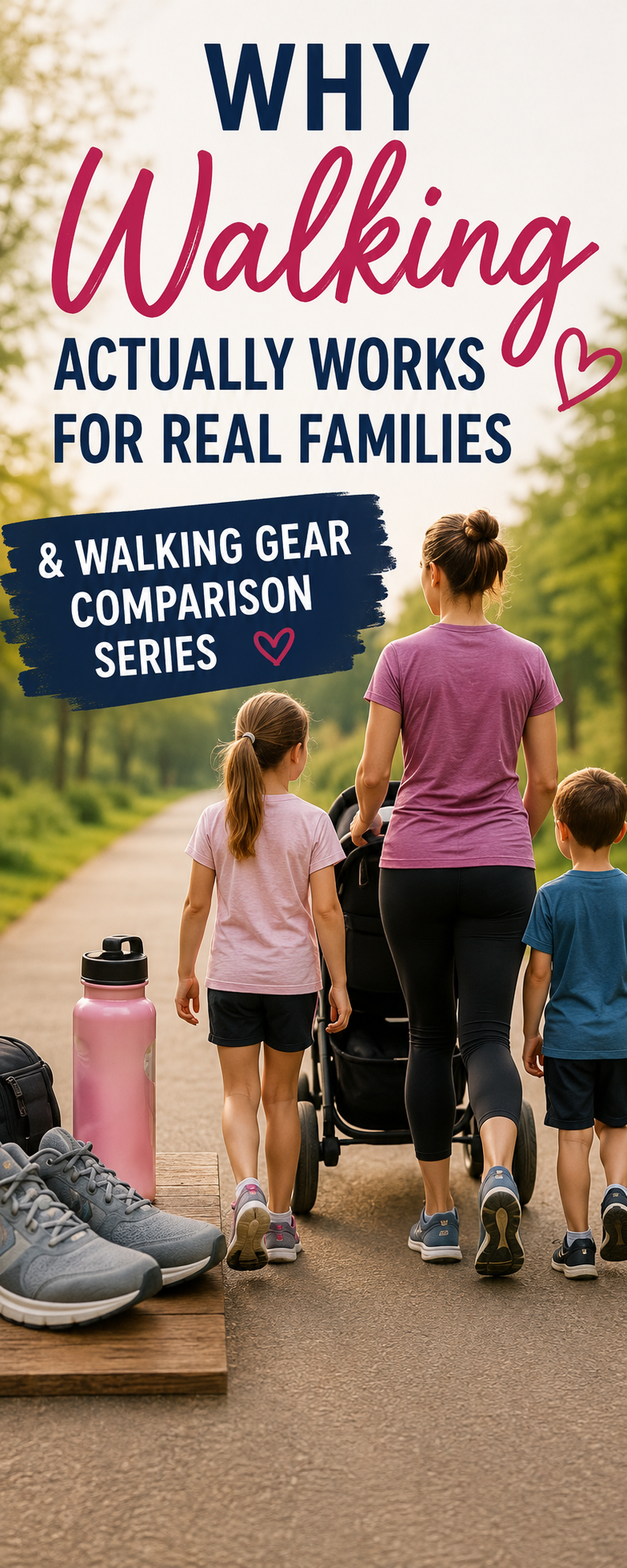
🌎 Walking Isn’t Complicated—It Just Has to Fit Real Life and for me personally as much as I hate to admit it its hard to fit walking into real life even though I know walking should be done daily not only to help me lose weight but to help me stay healthy and help my legs and knees become stronger.
For most families walking works not because it’s structured, but because walking doesn’t require equipment, memberships, or a perfect schedule. There is no, money involved. Walking just requires stepping outside and moving in a way that feels possible for your life right now.
For some families, walking is a reset after a long day. For others, walking is a way to get kids and teens out of the house without turning it into an event. For teens walking is independence. For pets, it’s the highlight of their entire day. For adults, walking is often the only quiet moment they get to think clearly.
What makes walking different from other habits is how many versions of walking can exist at the same time. A short loop around the neighborhood counts. A walk through a store counts. A slow evening stroll counts. Even pacing while life is happening still counts. And that’s the point. Walking only works long-term when it fits into real life instead of demanding a new version of it.
Somewhere along the way, many people started believing that movement only matters when it looks a certain way. If it isn’t a workout, a gym session, a fitness class, or a perfectly planned routine, it somehow doesn’t count. Walking reminds us that movement doesn’t have to be complicated to be valuable.
Most families are busy enough already. There are school schedules, work schedules, appointments, errands, household chores, and countless responsibilities competing for attention every day. Adding another complicated commitment can feel impossible. Walking succeeds because it doesn’t ask families to rearrange their entire lives around it. Instead, it slips into the spaces that already exist.
Walking can happen after dinner when everyone needs a break from the house. Walking can happen while waiting for a practice to end. Walking can happen during a lunch break, while running errands, or while taking the dog out before bed. Walking works because it meets people where they are instead of demanding more time than they have available.
For many families, walking becomes less about exercise and more about connection. Some of the best conversations happen when people are moving. Kids often open up about their day when there isn’t a screen in front of them. Parents have an opportunity to slow down and listen. Couples can spend time together without the distractions that usually fill the evening.
The walk itself may only last ten minutes, but the time spent together often matters far more than the distance covered. Walking also encourages people to notice things they might otherwise miss. A neighbor planting flowers. A new business opening nearby. Seasonal changes in the trees. Decorations appearing before a holiday. When people move through their community on foot, they experience it differently than when they drive through it.
Those small observations can make a neighborhood feel more familiar and connected. One of the biggest advantages of walking is that it grows and changes alongside life. A young family pushing a stroller walks differently than a family with teenagers. Someone recovering from an illness walks differently than someone training for a longer distance event. A retired couple enjoying an evening stroll walks differently than a parent trying to squeeze in a few minutes before dinner.
None of those versions are wrong. Walking doesn’t require people to reach a certain level before they begin. Walking doesn’t require expensive gear or a complicated plan. Walking simply allows people to start where they are. At there own pace.
That flexibility is often what turns walking into a lasting habit. People don’t continue routines that constantly feel like a struggle. They continue routines that fit naturally into their lives. The easier something is to repeat, the more likely it is to become part of a daily rhythm.
That’s why walking remains one of the most practical activities available to families. Walking works on good days and difficult days. Walking works when schedules are full and when schedules are open. Walking works when energy levels are high and when people are simply trying to do something positive for themselves.
Real life is rarely perfect. There will always be busy seasons, unexpected challenges, and days when plans fall apart. Walking leaves room for all of that. It doesn’t require perfection. It only requires a willingness to keep moving forward one step at a time.
And maybe that’s why so many families return to walking year after year. Not because it’s complicated. Not because it’s trendy. But because walking works in the real world, where life is messy, schedules change, and simple habits are often the ones that last the longest..
Would you want to join me on a walk this morning?
Thank you,
Glenda, Charlie and David Cates
Let us know if you enjoyed this post!

Like

Love

Happy

Haha

Sad