
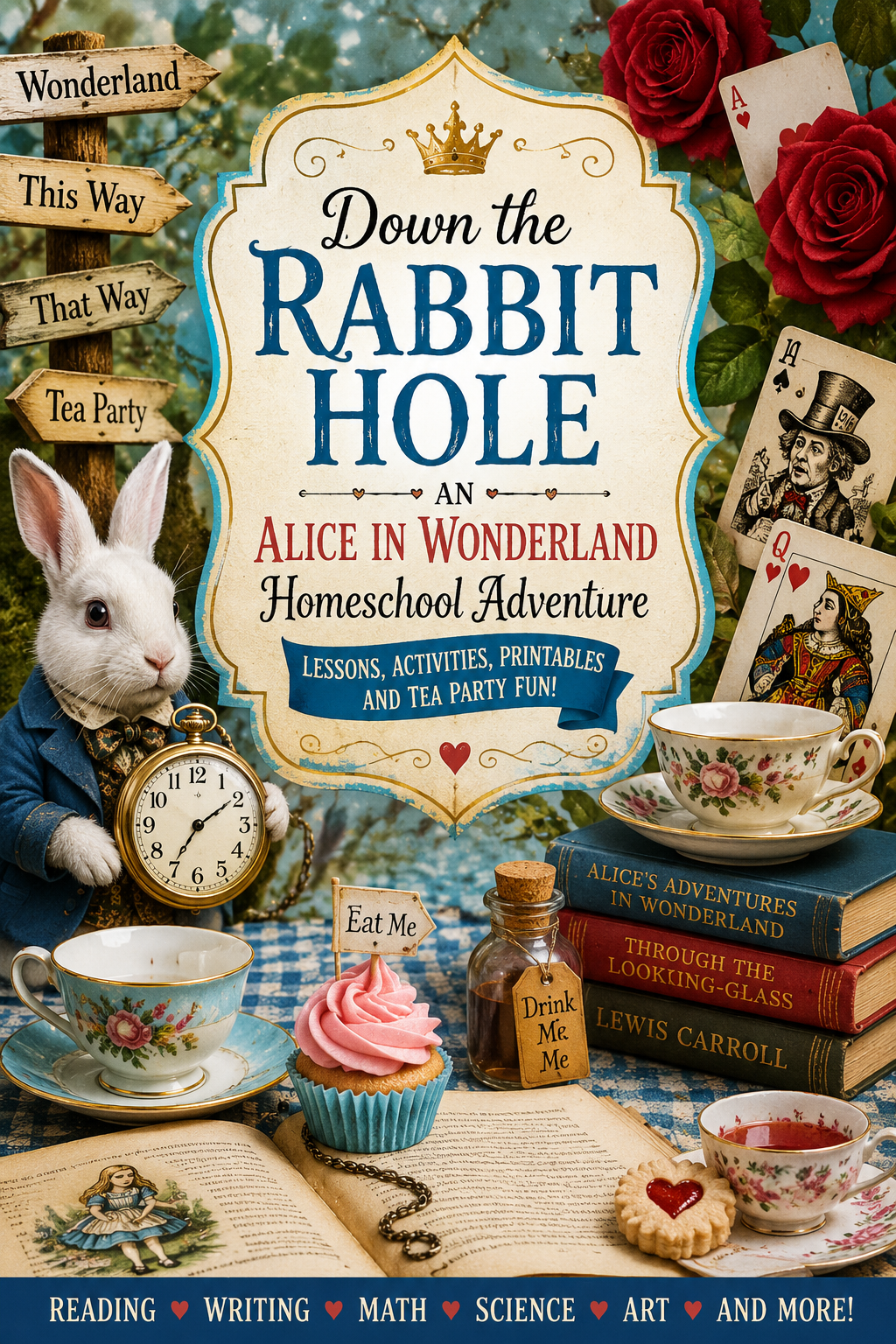
As a child I was always intrigued with Alice in Wonderland and loved watching the movie and reading the book. Here lately the more I work on the blog the more I feel like I’m going down the Rabbit Hole so I thought it would be fun to share a new lesson plan with you based on Alice in Wonderland creating a Homeschool Lesson Plan: featuring A Week of Learning Down the Rabbit Hole. Even though Charlie has graduated I wouldn’t mind doing this lesson myself. Would you want to join me?
For me and my family there are some books that seem to stay with us no matter how old we become. For me, Alice in Wonderland has always been one of those stories. It might be because Alice reminds us that curiosity is a wonderful thing, or maybe it is because the world Lewis Carroll created is so different from our own. Whatever the reason, Alice in Wonderland is one of those timeless books that children and adults can enjoy together, making it a perfect choice for a homeschool unit study.
Books have a wonderful way of bringing subjects together, and Alice in Wonderland opens the door to language arts, history, science, art, and even math. Instead of simply reading the book and moving on, families can turn the story into a memorable adventure filled with imagination and discovery.
Begin the week by reading a chapter or two each day. Younger children may enjoy having the story read aloud, while older students can read independently and then discuss what they have learned. Ask children what surprised them most about the chapter and encourage them to imagine how they would react if they suddenly found themselves following a rabbit into another world.
Language arts comes naturally with this classic. Children can keep a journal throughout the week and record their favorite scenes and characters. They may enjoy writing about what they would do if they fell down the rabbit hole or creating a conversation with the Cheshire Cat. Copywork using favorite quotations from the book can help with handwriting while introducing students to beautiful language.
Studying the author provides another opportunity for learning. Lewis Carroll, whose real name was Charles Lutwidge Dodgson, which I didn’t know and was a #teachingmoment for my family lived during the Victorian era. This time period offers plenty of opportunities to discuss history and compare life in the nineteenth century with modern life. Children may enjoy learning how families traveled, what schools were like, and how people entertained themselves before television and computers.
Science can also be discovered in Alice’s adventures. Rabbits, caterpillars, butterflies, flowers, and gardens all appear throughout the story. Families can study butterfly life cycles, plant flowers in containers, or observe wildlife in their own backyards. These simple activities help children connect literature with the world around them.
Math lessons become more enjoyable when they are connected to stories. Use playing cards for counting activities or create word problems inspired by tea parties and garden adventures. Baking cookies together also offers opportunities to measure ingredients and practice fractions in a practical way.
Art is perhaps one of the most enjoyable parts of an Alice in Wonderland unit study. Children can paint red roses like the card soldiers, design their own Mad Hatter hats, draw the White Rabbit, or create a colorful tea party scene. Art encourages creativity and allows students to bring their favorite parts of the story to life.
Toward the end of the week, celebrate with an Alice in Wonderland tea party. Simple sandwiches, cookies, and lemonade can transform an ordinary afternoon into something magical. Invite children to wear funny hats and share their favorite moments from the story. The experience becomes more than a lesson. It becomes a memory.
Families who enjoy movies may wish to compare the book with a film adaptation. Talking about differences between books and movies encourages critical thinking and helps children understand how stories are interpreted in different ways.
One of my favorite ways to end an author study is with a scavenger hunt. Hide small treasures around the house and allow children to search for items inspired by the story. A toy rabbit, a playing card, a teacup, or a key can turn an ordinary day into an adventure worthy of Wonderland itself.
The beauty of Alice in Wonderland is that it reminds us learning does not have to be boring. Education can be filled with curiosity, laughter, and imagination. Long after the lessons are complete, children often remember the stories they shared with family and the memories they created together.
If your family enjoys classic books, be sure to visit our other Alice in Wonderland activities including our tea party ideas, scavenger hunt, summer reading activities, craft projects, and printable resources. There is always another adventure waiting just beyond the rabbit hole.
Free Printable: Alice in Wonderland Reading Journal
Alice in Wonderland Reading Journal
Student Name: __________________________
Date: __________________________
My favorite character was:
___________________________________________________
My favorite chapter was:
___________________________________________________
The funniest part of the story was:
___________________________________________________
If I fell down the rabbit hole, I would:
___________________________________________________
___________________________________________________
My favorite quote from the book was:
___________________________________________________
I give this book ______ stars out of five.
If you’ve homeschooled your children and you’ve studied Alice in Wonderland and have ideas I didn’t share leave me a comment with what you did so families can expand there studies.
Thank you,
Glenda, Charlie and David Cates
Let us know if you enjoyed this post!

Like

Love

Happy

Haha

Sad